Thursday, October 28, 2010

HollaBack!

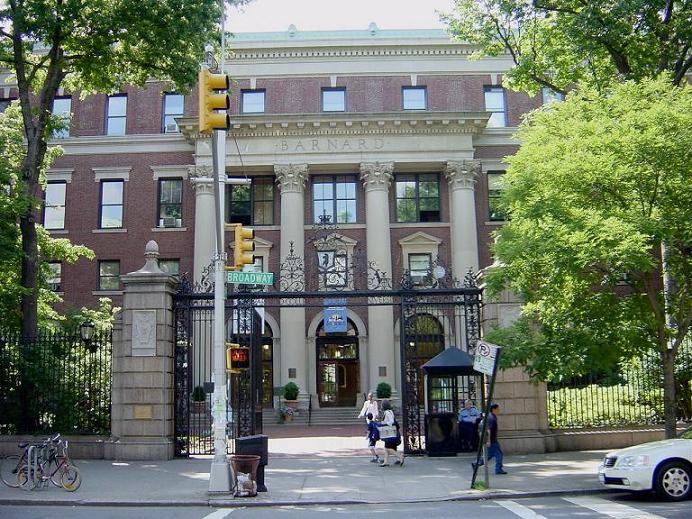
HollaBack! Another mailing from my alma mater Barnard College and its Barnard Center for Research on Women. I flipped the post card over to see phrases like "combat street harrassment" and "ending sexual harrassment." I flipped back to the front of the card to see an angry (or was she hurt) looking young gal holding up her hand as if to say stop . . . or hollaback?

When I actually read the text, the fog lifted at once. No, it's not an obscure word from some Spanish dialect. HollaBack! is about "feminist responses to street harassment." It's about creating safe transit and safe communities by ending sexual assault. It's about getting tough and street-wise. It's about women fighting! We're fighting back. We're HOLLERING back. I finally got it. Forty plus years into the feminist movement and according to the Barnard Center for Research on Women, we lady-folk are still victims. Society still doesn't treat us properly. The feminist movement may be gulping for air, but it hasn't breathed its last. And to prove it, we're going to finally make streets safe for women by using "technology, mapping and community organizing." Heaven help us.

Back in 1971, when the Center was founded, who would have thought that years down the road Barnard would be sending its alums mailings about hollering back, polyphonic feminism, erotohistoriography, economic and sexual justice and other such topics covered by 'sexuality scholars' and those whose area of expertise is 'gender/sexuality/queer studies.'

I'm often told that the current crop of Barnard undergrads is interested mostly in being good students and getting a sound education. Perhaps at this point the Women's Center is an afterthought, a 70s hold-over, a campus anomaly. I certainly hope so, and, in fairness, it should be added that not every mailing from Barnard is about reproductive justice (their term) and feminist art. The campus is also host to Bach concerts and back in February there was a lecture about raising happy and moral children.

Saturday, October 23, 2010

Tax Eaters vs. Tax Payers

There is a new book by Steven Malanga called Shakedown: The Continuing Conspiracy Against the American Taxpayer. Read about it here and watch below.

Wednesday, October 13, 2010

The End of Men?

A few months ago, OrignalMetalChik asked where are the men, the real men, that is. Only slightly more dramatic, Brian Caulfield, in the Winter 2010 issue of The Human Life Review, asks if it's the end of men. Thank goodness, he does predict their return.

Caulfield gives some of the factors contributing to the demise of fatherhood and manhood in our society (the Supreme Court decision of Roe v. Wade which left men with "no enforceable rights in the continued life of the child in the womb that they helped to create " and in vitro fertilization and donor conceived babies, methods that allow women to "start their pregnancy in a Petri dish" without ever having to deal with a living, breathing man and creating children whose biological father is a mere cipher.)

Caulfield cites the damage the de-masculinization of society has already done. Children in homes without fathers are five times more likely to be poor and 54% more likely to be poorer than their fathers. Child abuse is more prevalent in single parent homes than those where a child is raised by both biological parents.
Infant-mortality rates are almost twice as high for infants of unmarried mothers, and being raised without a father increases the likelihood of teen pregnancy and dropping out of school.

The mainstream media has, naturally, willingly reinforced the image of men as weak and silly creatures further fueling the damage done by a culture that has been swept along by the damnable women's movement of the 70s and the sexual revolution of the 60s.

However, Caulfied gives some indicators of how manliness is hopefully on the upswing again, citing in particular Pope John Paul II's Theology of the Body, the Pope's teaching and reflection on human sexuality. As Caulfied puts it, the Pope "draws energy from the very sexual revolution that it seeks to correct. Like a transformer station that takes raw energy and converts it into streams of electricity that are useful to a household, the pope takes the sexual energy unleashed in the 1960s, draws out the positive trends, and adds the tempering perspective . . . of the Christian tradition."

If you can't find this article on line, which I couldn't, you can certainly read more along these lines at Caulfield's website Fathers for Good of which he is the editor. Current wisdom has tried, lamentably with considerable success, to hammer into us that there is no difference between male and female despite appearances, experience and overwhelming evidence to the contrary. Thus, it's uplifting to be reminded that current wisdom is wrong, that "gender" is not a state of mind or an accident of environment, that the complementarity of the sexes is directed by God. As Caulfield writes,
"Men and women togther, equal in dignity and value, yet different in nature and capacities: This is the great model that John Paul sketched in his theology that placed the ensouled human body at the nexus of all history. "

Thursday, September 23, 2010

Saints and Heroes

Another beatification? Another saint? No sooner has one luminary of the Church been beatified--John Henry Newman--than another comes around. Having just returned from Our Saviour parish after the dedication of a new shrine (the first in the U.S.!) to the recently beatified Cardinal Newman, I chanced to read about the impending beatification of an Italian girl named Chiara Badano who liked to skate, dance and play tennis. What would there be about a seemingly normal teen that could possibly warrant her beatification?

At 17, Chiara was diagnosed with bone cancer and underwent chemotherapy, hospitalizations, unsuccessful surgery resulting in an inability to walk and, finally, months of pain before her untimely demise. On the one hand, there's the intellectual giant John Henry Newman and on the other a teen suffering from cancer, and both may be destined for sainthood. Hmm. There are, apparently, many ways to be "images of Christ." Chiara, with a devotion to and love of Christ, consciously decided, according to an incident related by her mother, to take up her cross and fully embrace her suffering as she prepared to "meet Jesus." Chiara died "happy" just a few weeks shy of her nineteenth birthday with the instruction to her mother that she repeat three times that Chiara is now "seeing Jesus." There is more about Chiara's beatification here.

At the same time, there was awarded the other day a Medal of Honor to Chief Master Sergeant Richard L. Etchberger for his heroism in Laos in March of 1968. With his crew lying dead and wounded around him, he "single-handedly held off the enemy with an M-16, while simultaneously directing air strikes into the area and calling for air rescue." As if that wasn't enough, he then proceeded, in the line of enemy fire, to lift not one, but three of his wounded crew into helicopter slings. Need it be said that as Etchberger was himself lifted into the helicopter, he was fatally wounded.

At first glance, Chiara and Chief Etchberger seem to have about as much in common as do Chiara and Blessed John Henry Newman. But reading the story of the Italian teen on one day called to mind reading the story of the soldier from just days before. Here are unusually courageous acts from otherwise usual people as they are confronted with danger, death and pain. They show a virtuous spirit that, once triggered, indomitably persists in being virtuous not only once or for a moment, but repeatedly and regardless of the last moment. Here are two who gave a somewhat unfathomable and conscious "yes" to personal sacrifice, the possibility of which, as a soldier, Etchberger was certainly quite aware and something Chiara certainly understood as her disease advanced.

Some time ago, I heard a talk by a rabbi who spoke, among other things, about the death of his parents in a concentration camp. The details of his story are a bit fuzzy now, but while his parents were carted off to a hideous end, his own boyhood was spared due to the heroic acts of some courageous individuals who looked after him. The rabbi gazed out at those of us in the audience and anticipated, as he probably had many times before, the questions that were on our minds, namely, Are you bitter, angry, vengeful? Are you guilt-ridden over your own survival? and Why are you so calm and reasonable?

To the unasked questions, the rabbi answered very matter of factly that he had learned quite early in life that human beings are--as he waved one hand to one side--capable of great evil and--as he gestured with his other hand to his other side--capable of great good. It's not pleasant to dwell on the suffering of a dying girl, the thoughts of a soldier under enemy fire, or the fears of those hiding a young Jewish boy orphaned by the Nazis. But it is pleasant after a fashion to dwell on their actions in the face of fear and danger as a reminder of the capability for great good that was placed within all of us.

College for Free Condoms

If college is indeed four years of partying as some recent books are saying, Drew University in Madison, NJ gives further proof that the college years provide for far more than just the refinement of the intellect.

At Drew, students are complaining because condoms are no longer distributed for free by the university's health office. Poor lambs. Resident assistants in the dormitories are now keepers of the condoms, and students who want condoms must go and ask for them. Such a hassle.

The fuss at Drew is not, oddly enough, over whether or not the college should dispense condoms. The issue is not even about the condoms being free. Rather, the brouhaha is over how the free condoms are being dispensed! At Drew, in the affluent suburb of Madison, parents who are spending just under $40,000 on tuition can certainly provide their young scholars with an allowance big enough to buy condoms. But money isn't the issue at all here. Values is the issue and therein lies at least some of the problem that plagues college life today.

The headline of the Star Ledger article would do all parents and students a greater service if it read, Why is a college promoting sexual activity among unmarried, still-financially dependent 18 to 22 year olds? And why do colleges provide contraceptives, abortion referrals, sex fairs, and, for that matter, co-ed dorms? If parents are suckers about anything, as some of the recent books suggest, we are suckers not to ask these questions when we make the rounds of college visits with our kids.

Monday, September 20, 2010

Alveda King and Restoring Honor Rally

Hopefully, Alveda King, niece of Martin Luther King, Jr. will become more of a household name now that Glenn Beck included her in his Restoring Honor Rally back on August 28th. Alveda King travels wherever Priests for Life sends her to carry her message on the "evil twins" of abortion and racism. As a Pastoral Associate for African-American Outreach of Priests for Life, King spreads the under-reported news that while blacks comprise only 12% of the general population, they have 35% of the abortions. King is one of the few in the pro-life movement to point out that a disproportionate percentage of abortion clinics are found in minority neighborhoods, supposedly to "serve" the poor. But, as King points out, "you don't serve the poor by taking their money to terminate their children."

Alveda King offends liberal, establishment blacks, or the Black Mafia as writer Lloyd Marcus calls them, because she doesn't deliver the required blacks-as-victims rhetoric. In her open letter of 2008 to the Congressional Black Caucus (CBC), King doesn't promote green jobs, free rides to community colleges or more government hand-outs. She talks about strengthening the black family, promoting marriage and family values. She reminds America's African-American leaders that the core mission of black civil rights groups is to ensure the equality of rights for all persons without recourse to violence or hatred. And, again, to the CBC, she addresses the issue of reparations saying,
the battle against oppression and segregation was not white versus black, but right versus wrong. There are no separate races divided by skin color. It was not whites who did this to blacks, it was Southern racists who even took us into a war where 300,000 whites gave their lives to end slavery. A political party based on abolition was formed by whites to free the slaves.

Hardly words that Maxine Waters, Al Sharpton, or, for that matter, Barack Obama, want to hear.

Alveda King offends white feminists when she says,

The abortion movement in this country was started by Margaret Sanger, the founder of an organization known today as Planned Parenthood. Ms. Sanger was quite open that she wanted "more children from the fit, less from the unfit." The unfit, she made clear, were blacks and poor whites. She had no qualms about speaking to as many as 12 Ku Klux Klan meetings. As I discuss in the new film, "Maafa 21: Black Genocide in 21st Century America" (produced byLifeDynamicsInc.), she targeted blacks in her eugenics-based campaigns.

And, Alveda King speaks out in a way that liberals find intolerable. When she invokes the dream of her Uncle Martin, and asks, How can the dream survive if we murder the children? she unsettles those who have whitewashed MLK, Jr. as little more than a "man of peace," a secular, kindly figure who wanted nothing more than a big group hug for the world. Columnist Johnathan Capehart scolds Ms. King for being a political opportunist at the Beck rally and "besmirching" her uncle's legacy. And columnist Bonnie Erbe is offended because Alveda King has dared to equate the pro-life movement with the civil rights movement and abortion with racism.

Erbe writes that she "supports abortion rights but I'm not sure I would go so far as to call it a human rights issue." Really? Highly doubtful considering that the operative mantra of the pro-abortion (reproductive rights) movement, the feminist (women's rights) movement, the homosexual (gay rights) movement has been to paint their respective causes as human rights violations and to create their movements in the image of the Civil Rights movement of the 60s.

Several years ago Alveda King spoke on the Barnard College campus at the request of the Columbia University pro-life student group. King arrived on a warm fall day in October wheeling her suitcase in front of her, having just come from another lecture tour. She has no entourage, no glamour, no flash and she gives her presentation by herself. Critics like Erbe and Capehart who desperately attempt to discredit King by saying she feeds on and distorts her uncle's legacy should attend one of her talks and note that there is humility in her presentation, not braggadoccio and that her message about the black experience in America, though not what the mainstream media wants to hear, is first-hand and true. Alveda King is tireless in her efforts to spread her message and Glen Beck deserves credit for supporting her.

College or No College?

There may be a new trend in the world of higher education. It's now becoming fashionable to say that college is a farce! Here is a review of several new books that points out how college is little more than four years of partying, that college is a rip-off and that we parents are all suckers for buying into the belief that our kids need four more years of classroom learning. The reviewer doesn't give these books very high marks, and they do sound a bit slap-dash, but most parents who've been through the college admissions process with their kids don't need these books to know that the path to college comes with a high price tag, both in terms of time and money not to mention everyone's emotional well-being. At the end of the day, college isn't always the best choice for every high school teen.

The number of kids who both genuinely aspire to the life of the mind after high school and who are qualified to do so must be a very small percentage of all graduating high school seniors, but we'd never know it because college has become de rigeur, the automatic next stop-over for all kids of 18, regardless of their strengths or interests. While I do know of a handful of teens who actively orchestrated their own college search, it is largely parents, college counselors and college admissions officers who fuel the college frenzy and perpetuate the myth that college is the only and best alternative after high school.

Popular belief says that college graduates have better earning power than those without a four-year degree, but Charles Murray gives a good explanation in this short article of why a college degree may not add up to higher earning power, depending on the individual.

And for those college students who ultimately may be good college material, he offers some pithy advice.

One of the best things we could do to improve the college experience for students and faculty alike is to persuade a new generation of high school graduates that they ought to get the hell out of the educational system for a few years and thereby learn something about themselves.